






Skip to content
WAEC · NECO · JAMB · and every exam after them

Walk in like
you have done it before.

For most people, exam day is the first time they ever answer questions with a clock running. 40 seconds each. No going back. Everyone around you turning pages fast.

Do it here first. Same clock, same paper, as many times as you like. Then exam day is just another one.

32
exams, from 6 exam bodies
Free
to write a paper. No card. Nothing expires.
Offline
if your network drops, you keep going
  • INTEInterview Preparation
  • APTIGeneric Graduate Aptitude
  • IELTIELTS (British Council / IDP / Cambridge English)
  • JAMBJoint Admissions and Matriculation Board
  • NECONational Examinations Council
  • WAECWest African Examinations Council
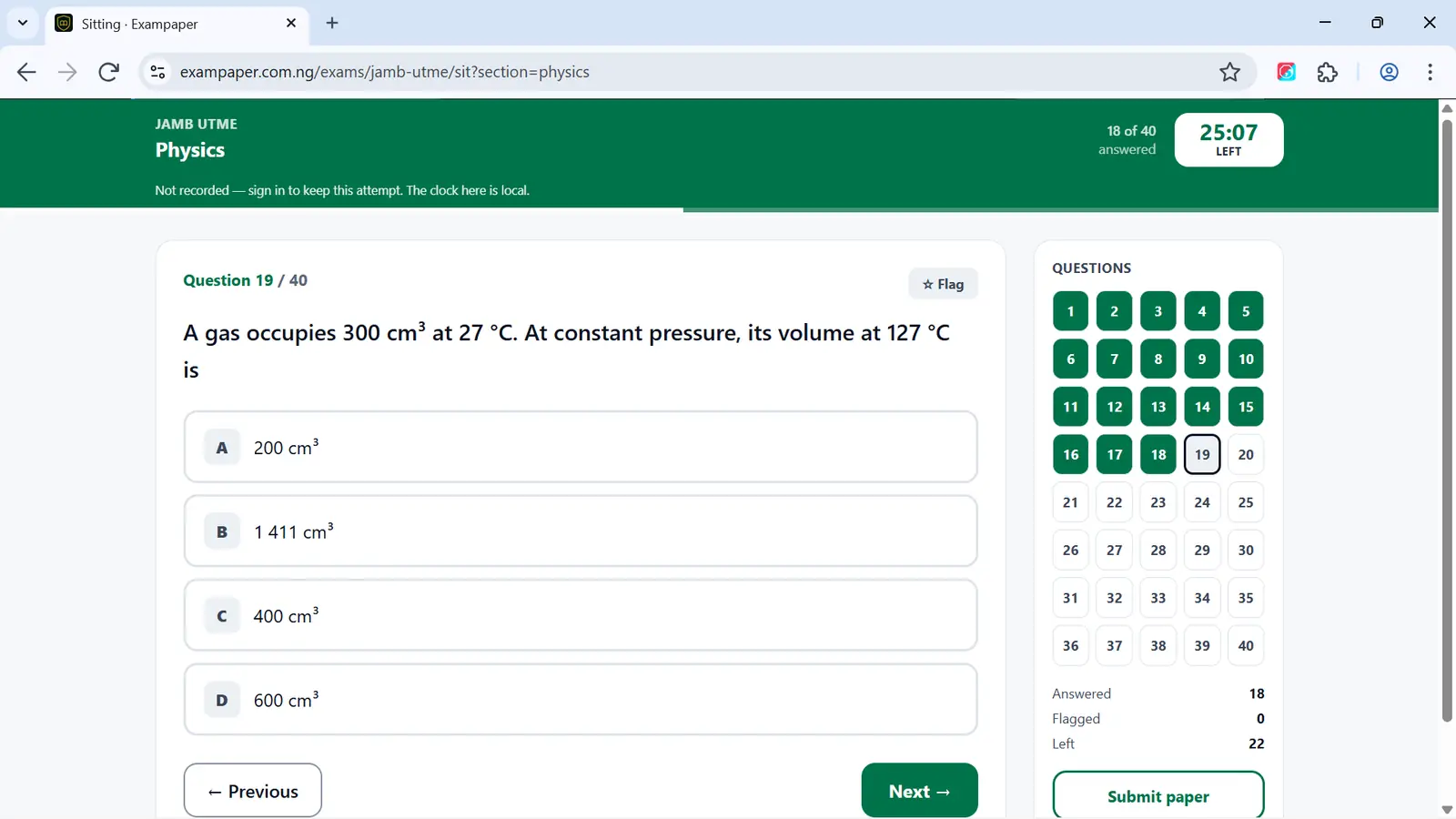
This is the real screen

Not a preview. This is the paper.

Question, timer, and the grid of every question in the paper so you always know where you stand — flag one, jump to another, come back before the clock runs out. Exactly what loads when you press start, on the exam you actually sit.

exampaper.com.ng/exams/jamb-utme/sit?section=physics
A JAMB UTME Physics practice paper mid-attempt: question 19 of 40 asks for the volume of a gas at constant pressure, with four options A to D. The panel on the right shows 18 of 40 answered and 25:07 left on the clock.
Why not just use a past-question book?

A past question you don’t time yourself on is just reading.


  1. I

    You cannot pause the clock

    The timer runs on our server, not on your phone. Closing the app does not stop it. Changing your phone time does not stop it. Same as the real thing.

  2. II

    Set up the way your board sets it

    How many questions, and how long you get — we take those from the board’s own syllabus and timetable, and we keep a note of where each number came from. Where we are not sure, we tell you instead of guessing.

  3. III

    You find out why you got it wrong

    Not just the right answer — why the one you picked looked right. Knowing you missed it changes nothing. Knowing what confused you is what raises your score.

Why does the clock run on your server?
Because a timer on your phone is a number in your phone’s memory, and anyone who wants more time can change it. When a paper opens, the server records the moment it must end. Every answer you send is checked against that deadline as it is written, so the countdown you watch is a display of the real one rather than the real one itself. Closing the app does not pause it. Neither does changing your phone’s clock.
Where do the question counts and time limits come from?
From what each board publishes about its own paper — the syllabus, the timetable, the instructions on the front page — and we record where every number came from alongside the number itself. Where a board does not publish something, we say we are not sure instead of picking a figure that looks about right. A practice paper that quietly invents its own rules is not practice.
How is an essay marked, and how much should you trust it?
Against the same criteria the board uses, scored one criterion at a time, with a quotation from your own answer supporting each score. The marker is required to fill in every criterion or the mark is rejected outright, so a plausible-looking band built from half a scheme cannot reach you. It also reports how confident it is, and anything below a threshold is flagged for a person. What it produces is a practice mark. A band from a test centre is a qualification and a band from us is not, and we would rather say so here than let you find out later.
Recognised examining bodies

Set up the way each board actually sets it.


  • Interview Preparation

    Interview preparation

  • Generic Graduate Aptitude

    Job aptitude tests

  • IELTS (British Council / IDP / Cambridge English)

    English proficiency

  • Joint Admissions and Matriculation Board

    School exams · NG

  • National Examinations Council

    School exams · NG

  • West African Examinations Council

    School exams · NG

3.7M+

candidates sat WAEC and JAMB last year alone. Most of them had never answered a real question under a real clock before the morning they had to.

Source: JAMB 2024 UTME registration figures (1,989,668) and WAEC 2024 WASSCE Nigeria school-candidate registration figures (1,814,344) — published by each board, not by us.

What we’ve actually built so far

62,491

questions written and checked

77

papers you can write today

32

exams covered

62

papers written by students

Every question here was written against the board’s own syllabus and checked before it went in. We tell you where each one came from.

1 paper finished in the last 7 days

Browse by format

Every exam is a different room to sit in.

A pencil and an OMR sheet is not a CBT cubicle, and neither is a face-to-face interview. Pick the format you are actually walking into.

6 examining bodies

Start with your own subject.

See all 32 exams

School exams

One paper at a time, on the real clock.


26 more exams in school exams →

Interview preparation

The questions they actually ask, answered out loud or typed.


Job aptitude tests

Numbers, words and patterns — the tests employers use.


English proficiency

Scored in bands, with feedback on your writing and speaking.


The part that runs quietly, every day

Exam day is not the first time you should meet a question twice.

How do you decide which questions come back, and when?
Each question you get wrong is scheduled to return, and the gap before it returns grows every time you recall it correctly. Get it wrong again and the gap resets. The effect is that you meet a question shortly before you would have forgotten it, which is the point at which practising it is worth the most. Answers you were certain about and still got wrong are treated more seriously than ordinary mistakes, because a belief you hold confidently does not fade on its own — it turns up in the hall as an answer written quickly and never checked.

Every paper you write is scored on the spot. What happens after is the part most practice tools skip: the questions you missed are quietly queued to come back to you, at the point you are about to forget them again — not sooner, which wastes your time, and not later, which defeats the point.

A question you got wrong doesn’t vanish into a score.
It comes back — a day later, then a few days later, then a week later — until you actually have it, not until you happened to see it once.
Ten questions a day is the whole ask.
Short enough to do before class starts. The streak is just a count of the days you showed up — nothing to buy, nothing that resets because you missed a payment.

Exam day feels smaller when you have done it before.

No card. Nothing to pay to start. Pick your subject and you can be writing in two minutes.

Pick your subject